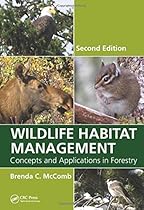
Wildlife Habitat Management: Concepts and Applications in Forestry, Second Edition
| Author | : | |
| Rating | : | 4.69 (778 Votes) |
| Asin | : | 1439878560 |
| Format Type | : | paperback |
| Number of Pages | : | 401 Pages |
| Publish Date | : | 2016-10-17 |
| Language | : | English |

DESCRIPTION:
About the AuthorBrenda C. She is responsible for over 80 graduate programs and 4500 graduate students at a large research intensive university, having spent much of her 36-year career engaged in natural resources research, teaching, outreach, and administration.. McComb, PhD, is Professor and Dean, Graduate School, Oregon State University, Corvallis
Samantha Conley said Student. This book is great for anyone intrested in wildlife management through a forestry perspective. So this book would also be great for a forester needing background information on habitat elements need for wildlife. It was writen really well and I learned so much from reading this book. I w
McComb, PhD, is Professor and Dean, Graduate School, Oregon State University, Corvallis. She is responsible for over 80 graduate programs and 4500 graduate students at a large research intensive university, having spent much of her 36-year career engaged in natural resources research, teaching, outreach, and administration.. Brenda C
Detailed appendices provide a glossary, scientific names, and tools for measuring and interpreting habitat elements. The author discusses assessment and prioritization policies, monitoring techniques, and ethical and legal issues that can have worldwide impact. It considers management approaches for specific habitats including even-aged and uneven-aged systems, riparian areas, and dead wood and highlights those approaches that will conserve and manage biodiversity. Writing in a species-specific manner, the author emphasizes the need to consider the potential effects of management decisions on biodiversity conservation and maintains a holistic approach throughout the book. In recent years, conflicts between ecological conservation and economic growth forced a reassessment of the motivations and goals of wildlife and forestry management. Drawing from the author’s more than 30 years working and teaching in natural resources conservation, Wildlife Habitat Management: Concepts and Applications in Forestry provides a synopsis of current preservation techniques and establishes a common body of knowledge fro