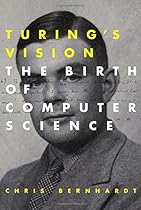
Turing's Vision: The Birth of Computer Science (MIT Press)
| Author | : | |
| Rating | : | 4.90 (751 Votes) |
| Asin | : | 0262034549 |
| Format Type | : | paperback |
| Number of Pages | : | 208 Pages |
| Publish Date | : | 2014-06-22 |
| Language | : | English |

DESCRIPTION:
Yanofsky, author of The Outer Limits of Reason: What Science, Mathematics, and Logic Cannot Tell Us)The dazzling array of computer applications, from desktop to cell phone, has obscured the play of ideas that first set our modern era in motion. Chris Bernhardt has written a very clear and accessible book that explains Turing's work, showing how his ideas have developed into some of the most important ideas in computer science today. (Ian Stewart, author of In Pursuit of the Unknown: 17 Equations That Changed the World)This is a delightful introduction for the lay reader to the ideas surrounding Alan Turing's great paper of 1936. (Noson S. I'm particularly impressed by the amount of detail the author includes while keeping everything simple, transparent, and a pleasure to read. A marvelous book. Dewdney, Professor Emeritus, Department of Computer Science, University of Western Ontario) . A fascinating account of
Delightful little book Jeremy Roach The best thing about this book is it will leave you hungering for more details from e.g. Martin Davis' Computability and Unsolvability.A Turing Machine in this book is described differently from what you'd find in Charles Petzold's The Annotated Turing. Instead of being in tabular form it's described by a "state diagram." These diagrams are introduced to describe finite automata, and a Turing Machine is presented as a finite automato. "What an outstanding, ground-up view of the technology and" according to John Kirk. What an outstanding, ground-up view of the technology and thinking that informs an increasing amount of how and what tools we use virtually every day to make decisions and, well, live.
Chris Bernhardt is Professor of Mathematics at Fairfield University.
As Marvin Minsky writes, "The sheer simplicity of the theory's foundation and extraordinary short path from this foundation to its logical and surprising conclusions give the theory a mathematical beauty that alone guarantees it a permanent place in computer theory." Bernhardt begins with the foundation and systematically builds to the surprising conclusions. In 1936, when he was just twenty-four years old, Alan Turing wrote a remarkable paper in which he outlined the theory of computation, laying out the ideas that underlie all modern computers. To explain Turing's ideas, Bernhardt examines three well-known decision problems to explore the concept of undecidability; investigates theoretical computing machines, including Turing machines; explains universal machines; and proves that certain problems are undecidable, including Turing's problem concerning computable numbers.. This groundbreaking and powerful theory now forms the basis of computer science. Turing wanted to show that there were problems that were beyond any computer's ability to solve; in particular, he wanted to find a decision problem that he could prove was undecidable. Bernhardt argues that the strength of Turing's theory is its simplicity, and that, explained in a straightforward manner, it is eminently understandable by the nonspecialist. He also views Turing's theory in the context of mathematical history, other views of computation (including those of Alonzo Church), Turing's later work, and the birth