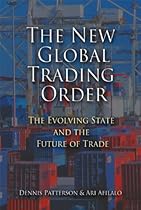
The New Global Trading Order: The Evolving State and the Future of Trade
| Author | : | |
| Rating | : | 4.92 (594 Votes) |
| Asin | : | 0521875188 |
| Format Type | : | paperback |
| Number of Pages | : | 288 Pages |
| Publish Date | : | 2017-04-24 |
| Language | : | English |

DESCRIPTION:
The international institutions that have governed global trade since the end of World War II have lost their effectiveness, and global trade governance is fractured. Today, a new form of the State - the post-modern State - is evolving. In this book, the authors propose a new trade norm - the enablement of global economic opportunity - and a new institution - the Trade Council - to overhaul the global trading order.. The key to understanding the global trading order lies in uncovering the relationship between trade and the State, and how the inner constitution of Statecraft drives the architecture of the global order and requires structural changes as the State traverses successive cycles. The current trade order, focused on the liberalization of trade in goods and services and the management of related issues, is predicated on policies and practices that were the product of a global trading order of the 20th-century modern nation-states. The need
not such a smart piece of work Khusro I find that the co-authors are somewhat opinionated, their writing driven more by what they believe ought to be the case and characterised by a lack of specifics when considering solutions.The narrative in one part is based on Bobbitt's and Cooper's works about the changing nature of the state (an ongoing phenomenon I would say rather than an event which happens on a specified date), and the changing economic relationships including how production and trade are organised (again an ongoing evolving phenomenon rather than a discrete event). My readin. James T. Ranney said A very disappointing book.. There are some good ideas (e.g., innovative measures to incentivize socially-worthwhile cross-border initiatives) here, but they are buried in a frustratingly disorganized repetitive jargon-laden jumble.Worse, many of their fundamental premises (which they keep repeating, as if mere repetition could make them true) are wrong. Probably their central premise is that "there is a fundamental contradiction betweencomparative advantageand thenotion of welfare" (which they define as the totality of national regulations to improve the lives of citizens). A. How to Modernize the Global Trading Order Serge J. Van Steenkiste Dennis Patterson and Ari Afilalo first clarify the essence of statecraft. Statecraft operates both internally and externally. Internally, the State is responsible for law and welfare. Externally, the State has strategic and trading relationships with the other States that make up the international society of States. Readers will benefit in this regard from first reading "The Shield of Achilles" by Philip Bobbitt to get the most from "The New Global Trading Order." In that book, Bobbitt spends most of his time covering the different mutations of the
Dunoff, Professor and Director of the Institute for International Law and Policy, Temple University Beasley School of Law"In this engaging new book, the authors show how the post-war Bretton Woods system for regulating the global economic order was predicated on a conception of the State that no longer holds. Kapstein, Paul Dubrule Professor of Sustainable Development, INSEAD, Visiting Fellow, Center for Global Development"The New Global Trading Order makes a significant and highly original contribution to the thinking about the