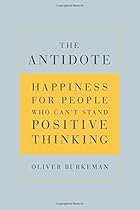
The Antidote: Happiness for People Who Can't Stand Positive Thinking
| Author | : | |
| Rating | : | 4.78 (507 Votes) |
| Asin | : | 0865479410 |
| Format Type | : | paperback |
| Number of Pages | : | 256 Pages |
| Publish Date | : | 2014-08-07 |
| Language | : | English |

DESCRIPTION:
He is a winner of the Foreign Press Association's Young Journalist of the Year award, and has been short-listed for the Orwell Prize. Oliver Burkeman is a feature writer for The Guardian. He writes a popular weekly column on psychology, "This Column Will Change Your Life," and has reported from New York, London, and Washington. He lives in New York City.
Exploring the dark side of the theories put forth by such icons as Norman Vincent Peale and Eckhart Tolle by looking to both ancient philosophy and current business theory, Burkeman--a feature writer for British newspaper The Guardian--offers up the counterintuitive idea that only by embracing and examining failure and loss and unhappiness will we become free of it. So in your next yoga class, try this: breathe deep, think unhappy thoughts--and feel your soul relax. But according to Oliver Burkeman, this relentless pursuit of happiness and success can also make us miserable. Best Books of the Month, November 2012: The you-can-do-it, life-is-one-big-smiley-face ethos of our contemporary culture has its val
Dustin G. Rhodes said Debby Downer was on to something.. I am a sucker. Feature a writer on National Public Radio, and the interview is mildly entertaining, I will buy the book. I will also probably read it -- the only question remaining: will I actually like it?The Antidote, for sure, is personally fascinating. I abhor positive thinking, gravitating instead toward reality. But I didn't come by this easily. In my early "Debby Downer was on to something." according to Dustin G. Rhodes. I am a sucker. Feature a writer on National Public Radio, and the interview is mildly entertaining, I will buy the book. I will also probably read it -- the only question remaining: will I actually like it?The Antidote, for sure, is personally fascinating. I abhor positive thinking, gravitating instead toward reality. But I didn't come by this easily. In my early 20's, I became obsessed with all manner of self help, positive thinking and new age spirituality. I devoured (embarrassing) self help books, feeling temporarily inspired by them while making feeble attempts to put the words into practice. Inevitably, I'd feel like a failure for . 0's, I became obsessed with all manner of self help, positive thinking and new age spirituality. I devoured (embarrassing) self help books, feeling temporarily inspired by them while making feeble attempts to put the words into practice. Inevitably, I'd feel like a failure for . Timothy Andersen said Finally a book for the rest of us. I picked up Antidote after hearing an interview with the author on Slate.com. The book is well-written, concise, interesting, and doesn't labor any point too much. The author clearly spent a lot of time researching the book, and some of his experiences were memorable, being presented in a witty, self-deprecating way.The discussion presented in the book is more philosophical than of the self-help variety. Self-help books are traditionally positive thinking books while philosophy books are not, so it is a natural choice. That is not to say that the book is dense or inaccessible. It is highly accessible to any reader with copious examples t. MichaelInVenice said Not a justification of pessimism, just the opposite. For those who walk around with a scowl on their face all day and hope to find in this book the secret to being happy while being angry, depressed or forlorn, this books will probably not the mark, because there is no mark to hit.But if you're just one of those many people out there like myself who's trying to avoid being angry and upset, but who doesn't buy the "be happy and wonderful things will happen to you" mantra, this book will be interesting. I say "interesting" not "enlightening" because it is a surface treatment covering everything from ancient stoicism to Buddhism to modern-day Santa Muerte beliefs and as such can't possibly be
Oliver Burkeman talks to life coaches paid to make their clients’ lives a living hell, and to maverick security experts such as Bruce Schneier, who contends that the changes we’ve made to airport and aircraft security since the 9/11 attacks have actually made us less safe. The Antidote is a series of journeys among people who share a single, surprising way of thinking about life. And then there are the “backwards” business gurus, who suggest not having any goals at all and not planning for a company’s future. And that there is an alternative “negative path” to happiness and success that involves embracing the things we spend our lives trying to avoid. What they have in common is a hunch about human psychology: that it’s our constant effort to eliminate the negative that causes us to feel so anxious, insecure, and unhappy. Burkeman’s new book is a witty, fascinating, and counterintuitive read that turns decades of self-help advice on its head and forces us to rethink completely our attitudes toward failure, uncertainty, and death.. It is a subversive, galvanizing message, which turns out to have a long and distinguished philosophical lineage ranging from ancient Roman Stoic philosophers to Buddhists