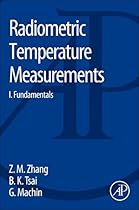
Radiometric Temperature Measurements, Volume 42: I. Fundamentals (Experimental Methods in the Physical Sciences)
| Author | : | |
| Rating | : | 4.13 (570 Votes) |
| Asin | : | 0123740215 |
| Format Type | : | paperback |
| Number of Pages | : | 376 Pages |
| Publish Date | : | 2016-10-26 |
| Language | : | English |

DESCRIPTION:
Excellent collection of recent advances in radiation thermometry avpro221 I am a leading author of Chapter 5 "Calculation of the Radiation Characteristics of Blackbody Radiation Sources".First of all, I'd like to point at the sad misprint: in the numerator of the first term in the right-hand part of the equation (31), p. 191: instead of c_sub_1(lambda) must be c_sub_1 epsilon(lambda)Overall, both volumes of this book contain unique materials on the theoretical and experimental radiation thermometry (pyrometry) never published before under one (two) cover(s). This is a doubtless merit of books' editors. The monograph reviewed is a m
This book describes the theory of radiation thermometry, both at a primary level and for a variety of applications, such as in the materials processing industries and remote sensing. This book is more than a practice guide, readers will gain in-depth knowledge in: (1) the proper selection of the type of thermometer; (2) the best practice in using the radiation thermometers; (3) awareness of the error sources and subsequent appropriate procedure to reduce the overall uncertainty; and (4) understanding of the calibration chain and its current limitations. A large number of references are included at the end of each chapter as a resource for those seeking a deeper or more detailed understanding. The authors of each chapter were chosen from a group of international scientists who are experts in the field and specialists on the subject matter covered in the chapter. This book is written for those who will apply radiation thermometry in industrial practice; use radiation thermometers for scientific research; the radiation thermo
Many of the pitfalls common in application of radiation thermometry are pointed out in these volumes, and methods for avoiding the common errors in application are given. Non-contact temperature measurement has many applications, as it avoids contamination of the measured material, can handle extremely high temperatures, and can usually (but not always) be a nonintrusive measurement method. "This reviewer was impressed by the scope and depth of coverage afforded to this rapidly developing and very important class of measurement techniques. These volumes should be a part of the library of anyone using radiation thermometry in engineering applications."--International Journal of Thermophysics
Since that time, he has worked in the Sensor Science Division at the National Institute of Standards and Technology. . Next, he obtained a MSME degree in 1990 at Purdue University by completing his thesis on “Dual-wavelength Radiation Thermometry: Emissivity Compensation Algorithms. In 1993 he finished a PhD degree at Purdue University with a dissertation entitled, “Macroscopic Spread Function Analysi