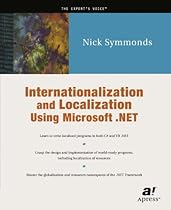
Internationalization and Localization Using Microsoft .NET
| Author | : | |
| Rating | : | 4.64 (540 Votes) |
| Asin | : | 1590590023 |
| Format Type | : | paperback |
| Number of Pages | : | 352 Pages |
| Publish Date | : | 2017-04-27 |
| Language | : | English |

DESCRIPTION:
Most importantly, with .NET you can use XML-based resource files for storing culturally dependent strings and graphics separately. As a veteran of building software for multiple languages (with considerable experience with Visual Basic 6), author Nick Symmonds shares his insight about techniques that work best for internationalizing software. Here the author shows off a way to extend the support for multiple resource files in VB6. With good reference sections on the relevant .NET classes and APIs that will be needed to develop multilingual software, some effecti
"Probably the only .NET loc book. Not recommended." according to A Customer. I have a bit of background in localizaiton engineering and I also wrote a few .NET apps (definitely not a professional level, though). Still I got lost in this book and my time was wasted.If you really try hard, you may get something out of this book, but you'll still be annoyed by Chapter Probably the only .NET loc book. Not recommended. I have a bit of background in localizaiton engineering and I also wrote a few .NET apps (definitely not a professional level, though). Still I got lost in this book and my time was wasted.If you really try hard, you may get something out of this book, but you'll still be annoyed by Chapter 3 "Using Multiple Resource Files in VB 6". I thought I bought a .NET book. The casual writing style may also make you feel that the author is looking down on you.I also have to say that this book often just lists the in. "Using Multiple Resource Files in VB 6". I thought I bought a .NET book. The casual writing style may also make you feel that the author is looking down on you.I also have to say that this book often just lists the in. A pretty good book, but (read on!) DISCLAIMER: I was asked to review this book by a few people who were disappointed that I did not have plans to revise my efforts for .Net in the immediate future. So keep in mind that I am an expert with high expectations, rather than someone who bought the book to learn about the topic.NOTE: I will call Mr. Symmonds "Nick" in the review but I do not actually know him. It just seemed too odd to be constantly referring to him as "Mr. Symmonds" when he made the effort to so carefully provide such a comforta. "Do not waste your time with this book" according to D. Noel. Our company purchased this book so that we could localize a C# .net project. This book offered very few technical details about important parts of the process.I found that the author wastes a great deal of space explaining concepts such as "The History of XML" and the basics of localization.The most glaring omission is the lack of source code for a "functional" globalized application that demonstrates the concepts of satellite assemblies. The lack of source code is a glaring omission on the part of the pu
Nick Symmonds works for the Integrated System Solutions division of Ingersoll-Rand, developing and integrating security software. He started his professional life as an electronics technician. He also enjoys woodworking, hiking, and exploring the hills on his motorcycle. While getting his bachelor's degree in electrical engineering from the University of Hartford, he started to gravitate toward programming. He lives with his family in the northwest hills of Connecticut and has recently become
Both methods of localizing code are discussed in this book. Author Nick Symonds is an experienced developer and project manager of Windows applications intended for use worldwide. Symmonds knows the advantages of localization in the design stage and the disadvantages of localizing a project after the fact. This project is not only useful as a product in itself, but is also instructive in how to write fairly complicated code in both .NET languages.. "Internationalization and Localization Using Microsoft .NET" shows how to localize code using Visual Studio .NET. VS .NET has quite a few tools available for the developer to aid in the localization process. These tools are discu